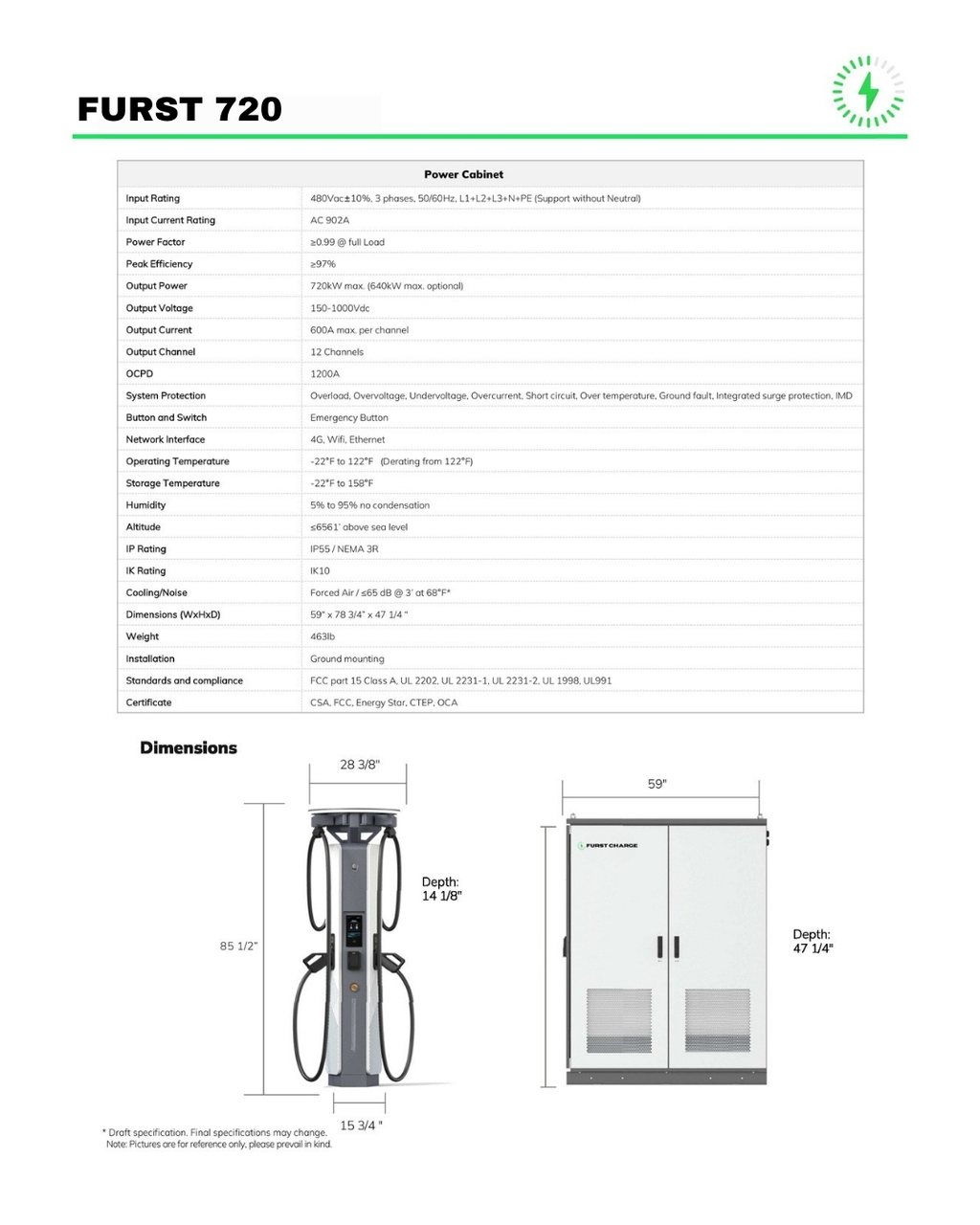
FURST720 High-Power DC Charging System
One power platform. Multiple charging positions. Built to scale with demand.
FURST720 is a modular DC fast-charging platform designed for commercial properties, fleet operators, public charging sites, and high-throughput destinations.
The system uses a centralized power cabinet connected to distributed charging dispensers. This allows property owners and operators to place charging points where drivers park while keeping the primary power equipment centralized for efficient site planning, flexible expansion, and simplified operations.
FURST720 is designed for locations that need to serve multiple EV drivers, support changing charging demand, and build a charging operation that can scale over time.
[Request FURST720 Pricing]
[Request a Site Feasibility Review]
Actual charging speed depends on vehicle capability, battery state of charge, battery temperature, available power, active charging sessions, power-allocation settings, utility capacity, and site operating conditions.
Why choose FURST720?
Scale charging without a large cabinet at every parking space
FURST720 separates centralized power equipment from the charging dispenser drivers use in the parking area.
This architecture gives commercial properties greater flexibility to design charging around real-world site conditions, including parking layout, vehicle circulation, building placement, customer access, fleet movement, and future expansion.
FURST720 can help operators:
- Serve multiple vehicles from one centralized charging platform
- Place charging dispensers where drivers actually park
- Build charging capacity in phases as demand increases
- Keep large power equipment centralized and easier to access
- Create a cleaner parking-lot layout with compact charging dispensers
- Support charging hubs, fleets, and high-volume public charging operations
- Plan for future charging spaces without rebuilding the entire system
Support multiple charging sessions
FURST720 is designed to support multiple charging outputs from one centralized system.
Instead of dedicating maximum power to every parking space at all times, the platform can distribute available charging power across connected vehicles based on the site’s final configuration and active charging demand.
This can help a charging location:
- Serve more vehicles during busy periods
- Improve site throughput
- Reduce driver wait times when properly designed
- Use available power more efficiently
- Build charging capacity around real utilization patterns
- Create a practical expansion path as EV adoption grows
The charging power available to each vehicle varies based on the final system configuration, vehicle capability, battery condition, charging demand, and the number of vehicles charging at the same time.
Built for high-demand commercial applications
FURST720 may be a strong fit for commercial operators that expect meaningful EV charging demand and need more than a basic charging amenity.
Ideal applications may include:
- Public EV charging hubs
- Highway-adjacent and travel-corridor locations
- Airports, rental-car facilities, and transportation centers
- Large supermarkets and regional retail centers
- Hotels, entertainment venues, and destination properties
- Fleet depots and commercial-vehicle facilities
- Municipal, transit, and government fleets
- Delivery, logistics, and service-vehicle operations
- Industrial and workplace campuses
- Commercial parking facilities
- High-traffic public-access destinations
The best projects combine convenient access, safe vehicle circulation, visible parking, meaningful demand, an electrical or utility-upgrade path, and a realistic operating plan.
Flexible power for passenger and commercial EVs
FURST720 is designed to support a wide range of compatible EV charging applications, including passenger vehicles and commercial fleet operations.
Furst Charge evaluates your vehicle mix, route schedules, charging windows, projected utilization, dwell time, parking layout, and infrastructure needs before recommending the appropriate number of charging positions, dispenser locations, and power-allocation strategy.
The goal is not simply to install the largest system available. The goal is to build a charging site that fits your drivers, your property, your utility capacity, and your long-term financial objectives.
Centralized power. Flexible charging layout.
Design charging around your parking area
FURST720 uses a centralized power platform with distributed charging dispensers. This gives a property more flexibility than a traditional one-charger-per-stall approach.
The charging dispensers can be placed where they make sense for drivers, while the primary power cabinet can be located where it is practical for electrical service, maintenance access, site safety, and property design.
This can be especially useful for properties with:
- Complex parking layouts
- Existing traffic patterns
- Fleet staging and vehicle circulation
- Limited space near the electrical service
- Multiple charging zones
- Future expansion plans
- Customer-access and accessibility considerations
- High-volume public charging operations
Intelligent power allocation
FURST720 uses a shared-power approach that distributes available output across active charging sessions.
As vehicles begin charging, reduce their power draw, or complete charging, available capacity can be allocated across the site according to the final system design and operating settings.
This makes FURST720 well suited for locations with changing demand throughout the day, including public charging hubs, fleet facilities, large commercial properties, and destination parking areas.
Built for long-term growth
EV charging demand is expected to grow, but not every property needs to build its maximum charging capacity on day one.
FURST720 supports a strategic, phased approach to charging infrastructure. A property may begin with an initial dispenser layout and expand as usage, EV adoption, fleet electrification, tenant demand, or customer traffic increases.
Furst Charge helps evaluate:
- Current and projected charging demand
- Existing electrical capacity and future utility requirements
- Initial charger and dispenser placement
- Expansion-ready conduit and infrastructure planning
- Parking-space allocation and traffic flow
- Utility rates, demand charges, and operating-cost exposure
- Network, pricing, and access-control requirements
- Future charging-hub or fleet-growth potential
A properly planned phased deployment can help avoid underbuilding today while reducing the risk of committing capital to capacity that is not yet needed.
Designed around your site
High-power, multi-vehicle charging requires detailed planning. Before recommending FURST720, Furst Charge evaluates the complete site and infrastructure path.
Our feasibility review may include:
- Existing electrical service, transformer capacity, switchgear, and available power
- Utility interconnection requirements, service upgrades, and construction timeline
- Existing building load and peak-demand behavior
- Expected charging utilization, site throughput, and operating goals
- Number and placement of charging dispensers
- Parking layout, vehicle circulation, accessibility, lighting, and safety
- Conduit, trenching, concrete, bollards, signage, and civil-work requirements
- Utility rates, time-of-use periods, demand charges, and energy-cost exposure
- Power allocation and energy-management strategy
- Network connectivity, payment options, driver access, and operational reporting
- Available utility make-ready programs, incentives, grants, or funding opportunities
- Monitoring, maintenance, service coordination, and future expansion planning
A property with limited existing electrical capacity may still be a candidate for FURST720. Depending on the site, Furst Charge may evaluate utility upgrades, load management, battery energy storage, phased construction, or a different equipment configuration that better fits the property’s electrical and financial requirements.
What Furst Charge provides
Furst Charge supports more than equipment procurement. We help commercial operators evaluate, deploy, operate, and grow EV charging infrastructure.
Our services can include:
- Commercial site feasibility review
- Electrical, utility, and infrastructure assessment
- Fleet, public-charging, and charging-hub strategy
- Charger configuration and dispenser-layout planning
- Utility-rate and demand-charge analysis
- Preliminary project budget and pro forma development
- Utility coordination and infrastructure planning
- Incentive and funding opportunity review
- Equipment sourcing and logistics
- Civil-work and installation coordination
- Commissioning, testing, and network activation
- Pricing, payment, fleet access, and driver-access setup
- Remote monitoring and operational support
- Maintenance coordination and expansion planning
Is FURST720 right for your site?
FURST720 may be the right solution when your property or operation needs a scalable, multi-output DC fast-charging platform capable of serving multiple vehicles from centralized power equipment.
It is best evaluated for commercial sites with substantial anticipated demand, a realistic electrical and utility path, safe parking and traffic flow, and a long-term business case for high-throughput charging.
Start with a site feasibility review. Furst Charge will evaluate your property, utility capacity, electrical infrastructure, charging demand, dispenser layout, operating-cost exposure, potential funding opportunities, and expansion plan before you commit capital.
[Request FURST720 Pricing]
[Request a Site Feasibility Review]
Call or text: 1-855-GO-FURST
Email: info@furstcharge.com
FURST720 availability, power rating, output-channel count, dispenser configuration, connector options, cable-management features, payment functions, communications, environmental ratings, warranty terms, installation requirements, and lead times depend on the final equipment configuration and applicable project conditions. Actual charging speed and energy delivery vary by vehicle, battery condition, active charging sessions, power allocation, utility supply, site load, and operating conditions. Project costs, utility requirements, incentive eligibility, utilization, charging revenue, and financial performance vary by site and are not guaranteed.